Max Match Play discussion

I posted this in the Match Play thread but was recommended to also post it here.

I finally had someone leave mid-tourney in a Max Match Play tournament and had a chance to put my workaround to the test.

Basically, if a player leaves I add a new Dummy Player and Dummy Arena, then I take the current match the absent player is on, replace their opponent with the Dummy Player and change their arena to the Dummy Arena and just leave them there while the tournament goes on. This way, the player’s completed games are not disregarded so their previous opponents are not affected other than dragging down their Strength-of-Opponent tiebreaker value.

As an added bonus, after missing a few rounds, he showed back up and I was easily able to add him back in by completing his match with the dummy player, and then deleting the dummy player and removing the dummy arena from the tournament.

Im sure there are plenty of ways for this approach to mess up in some way but, in this instance, it worked out well.

@haugstrup recently added a new feature for Max Match Play.

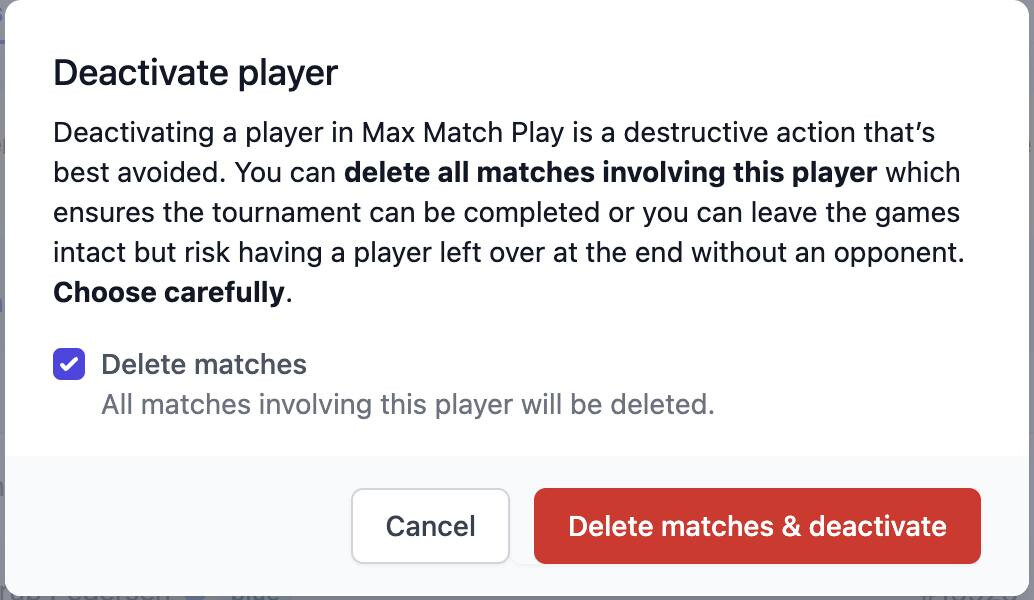
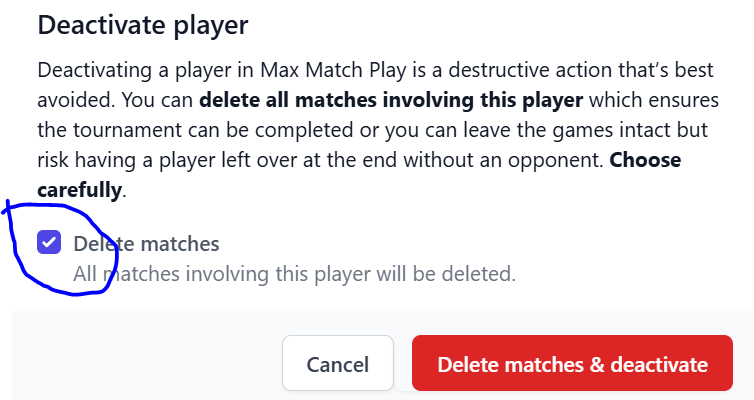
If a player leaves the tournament early you now have a choice between deleting all matches involving that player or leaving those matches intact. Choose the option that best fits your tournament.

I think it’s great to have this option, but using it does have the potential of causing some other trouble for the tournament. This problem comes up when you use the new option to not delete matches for someone leaves after playing an odd number of matches. I wrote up my thoughts on how the TD can adapt the tournament to handle this situation when it comes up. There’s no best answer here as they all have pros and cons. I suggest you pick a strategy (or a decision tree of strategies for different circumstances), write that plan into your IFPA calendar submission, and stick to it if the issue comes up.

Description of the problem

As the Deactivate player description says, “you can leave the games intact but risk having a player left over at the end without an opponent.” I think it’s easier to understand the scenario of “player left over without an opponent” if you think of it it as a “half-game problem”.

You have a tournament with Players A, B, and C.
Tournament duration is 2.

A plays B.
A plays C.
Player C leaves the tournament.
Now you’re stuck.
A has played 2 and can’t play any more, but B has only played 1 and needs to play 1 more.

To describe this problem more generally, you can think of each game as being two half-games. The total number of half-games that need to be played by people remaining in the tournament needs to be even for the pairings to work at the end. When player C leaves they take 1 half-game out of the pool of games to be played. There are a total of 0 half-games to be played from A and 1 half-game to be played from B. Every time you play another game you’re subtracting two half-games, so you’ll never get back to an even number of half-games even if you increase or decrease the duration.

Options for handling the problem

A. Deactivate the player who left then delete their most recent result. Their opponent from that game will have to play a game against someone else to replace their deleted game.

B. Include the player who left in pairings one more time. That opponent gets a free win. Then deactivate the player who left.

C. Do nothing when they leave and get lucky when a different player leaves later in the tournament also with an odd number of games played. (They balance each other out.)

D. At the end of the tournament, when the last pairing is created you’ll have 1 player waiting with 1 game to play and at least one active match with 2 players on their last game. Play that game as a 3-player game. Use adjust points to give the waiting player +1 point if they get 1st or 2nd.

E. At the end of the tournament, pair the player who needs a game with someone who already has the maximum number of games. This game is not recorded in match play. If the player who needs a game wins give them a +1 point adjustment. The points of the player who they’re paired against is not affected by the result of this game. (Recommendation to choose this player as someone who is one point ahead of the player who needs a game so they have some natural incentive to defend their spot in the standings rather than giving up a point and creating a tie.)

F. Increase the duration by 1. (Only works if you started with an even number of players.)

Combining options

You may want your tournament’s rules to lay out a plan for different solutions depending on the situation.

Here are some examples:

A + B: In the situation where a player leaves the tournament early we will evaluate whether that would result in a situation where the tournament ends with impossible pairings (e.g. the player had completed an odd number of matches). If it does and the departing player had won their previous match, that match result will be deleted and their previous opponent will get a chance at replaying that game with a different opponent. If the previous match was a loss for the departing player, then they will be included in pairing one more time and the player in the new pairing will get an automatic win (i.e. the player is not considered dropped until they do not show up for that newly paired match).

F + C + D: In the situation where a player leaves the tournament early we will evaluate whether that would result in a situation where the tournament ends with impossible pairings (e.g. the player had completed an odd number of matches). If the tournament had started with an even number of players we will increase the tournament duration by +1 match. Otherwise, we’ll wait until the end of the tournament before addressing the situation. If another player leaves later also with an odd number of games completed then no changes will be needed. If we get to the end of the tournament where creating matches results in one player left with a single game to play and all other players paired off for their final game, then we’ll randomly choose one of the games that was just created and will play that as a 3 player game. We’ll randomly determine player order for that game. Match result and Adjust Points will be used to record the result such that the 1st and 2nd place players both get a point and the 3rd place player does not get a point.
4 Likes

Many thanks for the implementation. This helps a lot.

In Europe, a lot of head-to-head is played, but more often Swiss than MM
One of the reasons for this is that you have to do some tricks at the end of the tournament to make it work without that you have duplicate pairings.
It’s very good that you can limit the number of simultaneous games, but you still don’t have a direct influence on who gets paired.
-It would be great for the future if you could pause players who have already played a lot more games than the others. It would also have the benefit for exampe of allowing players to eat without stress.
-As an alternative to “Create number of matches” would be creating matches only for players with already played maximum X number of games would also be a good idea for the future.
As my english is not perfect here an example: Some players have played only 8 games, but some have already played 12, you could then determine that only players who have played a maximum of 11 games are drawn.

Have you tried it? I think the new feature can be used to accomplish what you described as pausing a player.

Deactivate the player who needs to be paused; uncheck the delete matches checkbox; activate them again when they return.

You may need to keep an eye on the number of matches other players play while someone is paused. If you go past a round robin then I would expect repeat pairings before everyone has played the paused player. There’s nothing wrong with that necessarily, but it may not be what you and your players expect.

I just tested it and it works great. Would it be possible to set the checkbox for deleting players with the last entry?
I run MM tournaments with more than 50 players. For example, last third of the tournament, I would have to uncheck 5-15 players every round. It is also very dangerous if you want to be quick and accidentally and want to pause a player but forget to uncheck it. Since there is no further warning, all games would be deleted, which could be a disaster.

Since this function is certainly used extremely often just to pause players, it is perhaps safer to generally set the checkbox directly so that the games are not deleted, so that such an Desaster does not happen.

I have another question:
Over the years many duplicate players have been created. Some of them even have the dublicate IFPA numbers.
Is it possible to delete duplicate players or do I just have to rename them?

Problem with rename is that in older tournaments, Name would also shown renamed.

That’s fine feedback. I’ve change the checkbox so it defaults to off.

There’s an entire player merge tool available so you can merge duplicate players: Match Play Events

You can also “retire” players. Then they won’t show up when you look for players in new tournaments.

Great many thanks for your support.
You do really great job with matchplay.events

The duplicate IFPA numbers should be fixed by the IFPA. Honestly this should never happen as it’s quite possible to cheat/“sandbag” this way.

That’s a misunderstanding. No same IFPA number for different player
There are same duplicate player with same ifpa-number

The new option to pause players by temporarily deactivating them is a great thing. This way, everyone can take a break when they want and it’s particularly useful in my location because there’s simply not enough space for everyone to take a meal break at the same time with almost 60 players.

However, the deactivation function is too time-consuming in larger tournaments to pause players who have played almost all the rounds towards the end of the tournament so that everyone plays the last two rounds at the same time to avoid multiple identical pairings.

I used the following trick: 28 rounds were planned. Previously, I also had a limited number of 24 rounds. When almost everyone had reached 24 rounds, I increased it to 26 rounds and when most of the 26 rounds were reached, I increased it to the final 28 rounds.

This is a lot of work and confuses the players. As I have mentioned before, it would be better not to specify how many games are created when creating the rounds, but to specify that “only players who have played a maximum of x rounds” are drawn. This is the only way to ensure that you don’t end up having to play the same players repeatedly without too much effort for the TD.

Yesterday, we had an MM tournament with 58 players.

For me, this is still the best head-to-head tournament format. I was very pleasantly surprised by the new layout. For example, you can now see the number of rounds played for both active and inactive players.
We used the trick I mention here. In the end, we only had one pairing that had played each other twice.

However, I had the feeling that, in general, the pairings had been improved with the current software version and that players who had played many more rounds than the others were not drawn.
Is that the case, or was my perception incorrect?

Nothing has changed in the pairing algorithm, but I’m glad you like the layout changes :slight_smile:

The layout turned out great overall.

We organized a small MM test tournament. I noticed that, as scorekeeper, I was able to enter my results on my cell phone, which created duplicate player-pairing after drawing a new game.

As a note to everyone, please enter results on a single terminal only to prevent this from happening.

While flip frenzy tournaments should only have results entered on a single device the same is not true for Max MP tournaments. For Max MP you can use multiple devices.

In Max MP you can in some cases end up with the same players playing each other back-to-back. For example, if both players have a spot open for a repeat opponent.

Sorry for confusion. My fault. It was flip-frenzy when I entered a result on my phone and it made error in new pairings.

In MM of course you can enter your result without any issues.
The only error I had in MM when “create new games” same time on 2 devices.

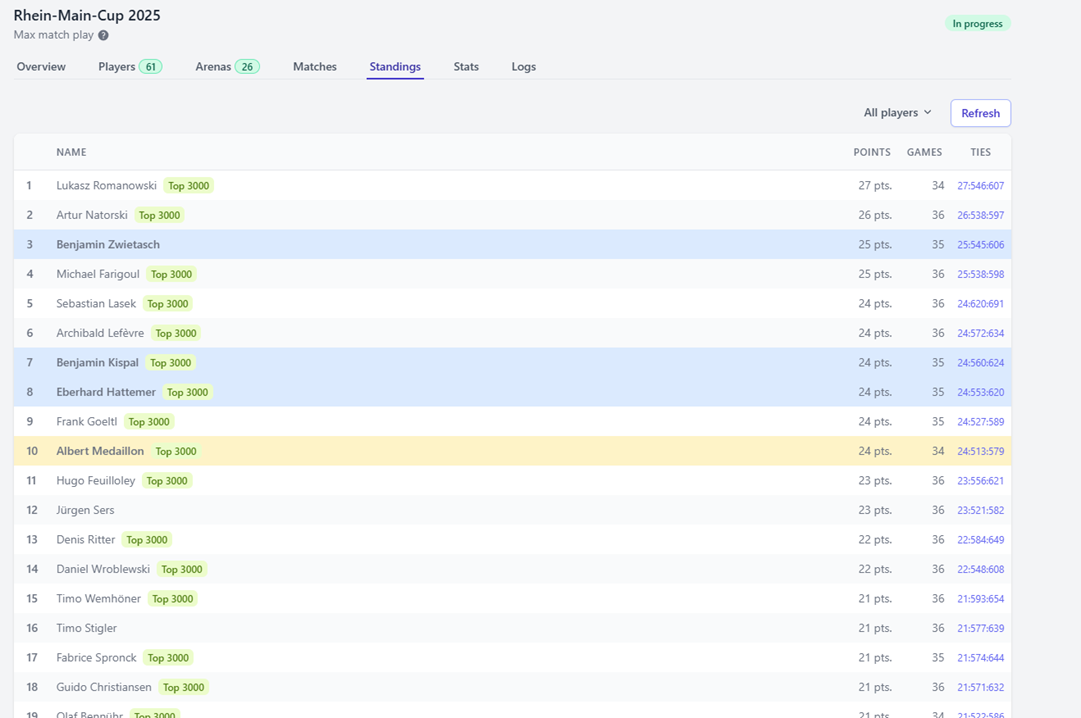
We have a very big problem with an MM tournament that we started today and will continue tomorrow.

It is a certified tournament, so there are 40 rounds in total.
Since we want to avoid double pairings, we initially scheduled 36 rounds and wanted to gradually increase to 38 and then 40 after everyone had completed their 36 rounds, as we have been doing for a long time.

There was no fixed break, so we offered each participant a flexible maximum 1-hour break by deactivating and reactivating the players.

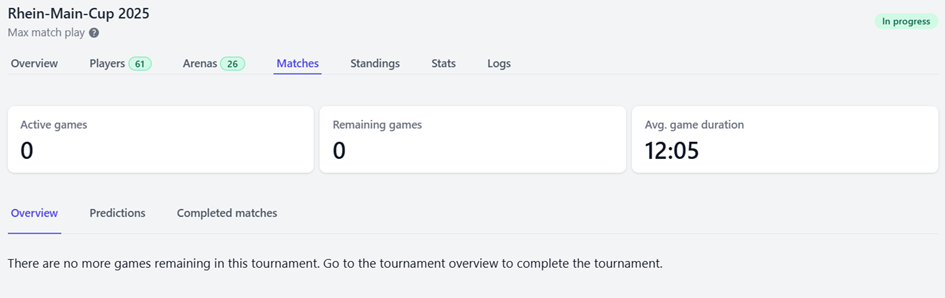
What we had seen before was that deactivating and reactivating the players caused the “Remaining Games” to be displayed incorrectly, which we had always ignored.

Now, even though the players were between 33 and 36 rounds, 0 remaining games were displayed and new pairings were not allowed:
And that at this stage:

We helped ourselves by increasing the rounds to 38, which allowed us to continue playing.
We changed all pairings manually so that we took a break at 36 rounds.
We are now very afraid that we will experience something similar again tomorrow.

It is now midnight here in Germany. I am going to sleep now and would be happy to finish the tournament tomorrow morning without it happening again that no more games can be generated before the 40 rounds have been played.

Your problem is likely your mass deactivation of players throughout the tournament. As you know Max MP for the longest time would force the TD to delete matches when deactivating a player.

Some TDs insisted that this is not what they wanted so I added an option to let matches remain when a player is deactivated. I included a warning that the app wouldn’t be able to guarantee that the tournament would be able to conclude properly in when used. I guess I should’ve made that warning even more clear.

Do not mass deactivate players. When creating matches MP needs to know how many players are in the tournament in order to decide how many potential repeat opponents are available. If you deactivate players that count will be wrong and you can end up in a situation like yours.

So let me repeat again: Do not deactivate players to give them a “break” and your tournament should be fine.

1 Like

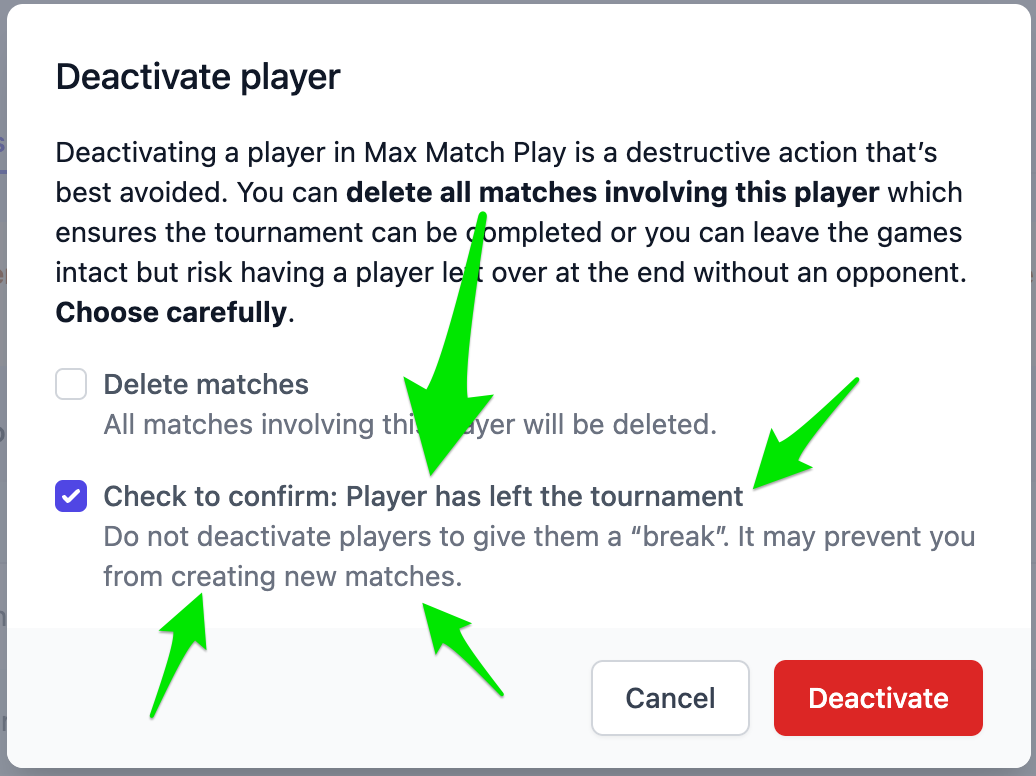
There is now a mandatory checkbox that must be checked before deactivating players in Max MP. It was either that or go back to the old way where a player’s matches would always be deleted.

1 Like

A long time ago, I suggested that it would be very useful for MM to be able to give players breaks. There are many reasons for this. At some locations, it is not possible to give everyone a break at the same time due to space constraints. It would also be helpful to be able to give technicians or other co-organizers who are playing themselves flexible breaks.

The response at the time was to deactivate players as needed after the software was adjusted and their games no longer had to be deleted.

A major issue is the effort required to avoid having the same players compete against each other multiple times at the end of the tournament. I try to control this by, for example, allowing 16 rounds out of 20 planned rounds at first, then increasing to 18, and only going to 20 at the end. Nevertheless, it happens that players have duplicate opponents. Before I handled it this way, the problem was even bigger because many ended up playing each other multiple times while others were already finished.

I have only one concern that would make MM perfect from my point of view, and I have mentioned it before: When drawing lots, it should be possible to specify that only players with a maximum of x rounds will be chosen. Currently, you can only set the maximum number of games to be generated, but that doesn’t help because players who have almost completed all rounds are often selected simply because no other opponents can be found.

I love MM, but many in Europe don’t use it because it doesn’t work as easily as a Swiss system.

While in Europe, outside of Pingolf and Group Matchplay, around 95 percent of games are played head-to-head and only around 5 percent are card-based, in the US it feels like the opposite is true: over 90 percent of formats there are card-based, with less than 10 percent head-to-head.

Hello,

I play about 30 tournament days per year in europe. Last year in Germany, Spain, Poland, Finnland. The tournaments I played @pinmaniacs place had been very efficient and the day had a very nice flow. One of the reasons for this is Max Matchplay being used. However there is still room for improvement, and I think the possibillity to give players breaks would be very beneficial. Personally I like to stay in the flow and not do long lunchbreaks. For this having a pause of 10-15min with a “log off/pause button” would be perfect.

Also the points mentioned for technicians and co-organisers are very valid.
At the end of the day, with a pause button and good organisations 35 to 40 games should be doable on one day and a great experience.

“it should be possible to specify that only players with a maximum of x rounds will be chosen.” This also makes a lot of sense.

Kind Regards

Sebastian

1 Like