dip 14 coin switch same/separate would probably be better to hijack.
Or maximum credits, make one just switch between 8 and 20 max, the other for the freeplay. (I’ve found that operators really, really, really, dislike when you mess with coin ratios or max credits for people that route their games.)
Thanks for that feedback, @scochar. I have working code using DIP 30, and I was able to re-use the ROM space taken by the previous DIP 30 code. One thing I liked about it is that you could easily switch in and out of Free Play without messing with any of the coin ratios. I had considered DIP 14 as well, but an operator might want that if they had two coin slots that need to work together (quarters in either slot count) for the coin ratios/bonus credits.
I haven’t fully understood how someone would use DIP 30 on a routed game. Are there coins or bill adapters where an operator would need to give players more than 10 credits for a single coin/bill? And why is it +9 instead of +10 if the game already has settings for 1-10 credits for a single coin? I figured that most people currently using that switch were doing so in an attempt to keep credits maxed out because they don’t have a Free Play option.
Regarding what to display for credits, I found the asterisk (*) too distracting since it’s almost always present (except when showing text on that display). I’m leaning toward just leaving the credit area blank, or using a hyphen (-) to indicate that the game’s configured for Free Play.
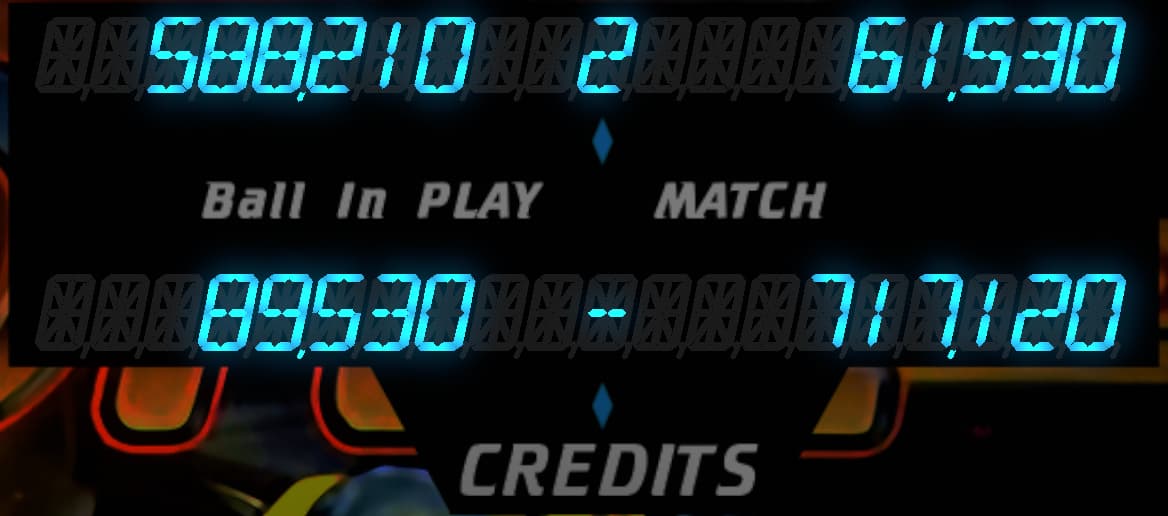
This is an emulated display from a 4-player game. If you had big “FP” letters there, I think it’d just be distracting/confusing. 2-character credits use the existing ‘-’ position and the position to the left. So Player 3’s score would look like “89,530 FP”
Version 1.3 extends DIP switch 32’s existing liberal/conservative setting to control FUEL drop target behavior. The “liberal” setting (switch on) is the default behavior of resetting after hitting a flashing “L” or dropping all targets. The “conservative” setting (switch off) removes the behavior of resetting the bank when all targets are down, but resets the targets on any completed shot to the upper right ramp (100K shot) or orbit (checkpoint 3). With this change, it shouldn’t be necessary to disable the upper-right flipper to prevent chopping wood with a “drop targets all day” strategy.
You might want to create a new post to ask outside this thread and get a wider audience.
There’s also an interesting project, GORAT80, which allows for replacing the dual PROMs with a single 32KByte EEPROM that can hold two images – one with game code, and the other with hardware test code.
That could be an attractive option as it becomes harder to source the small EEPROMs used on older games. You still need a ROM burner, and in this case some experience with combining ROM images.
@JoeTheDragon, the memory layout of Gottlieb System 80B is a bit of a mess, so there’s no simple way to put a large EEPROM in the game.
For example, on a game with an 8KB and 4KB ROM, you have the following addressing:
0x1000-0x17FF: First 2KB of PROM2
0x1800-0x18FF: 256 nibbles (4-bit values) of NVRAM
0x2000-0x3FFF: 8KB of PROM1
0x9000-0x97FF: Second 2KB of PROM2
Notable is the need to carve out space for NVRAM, and that PROM2 is split across a large address range (guessing A15 of game connected to A11 of ROM). The PROM1 image uses normally addressing.
The GORAT80 board includes a PIC microcontroller that’s probably managing chip select and address I/O lines to map those non-contiguous addresses to a contiguous area of the 32KB EEPROM chip. One of the DIP switches likely controls an upper address bit so memory reads route to one of the two 16KB images stored on the chip.
You can stick everything in a 512 on an adapter since it’s the full address space you just have to format it correctly.
I think Joe was referring more to taking the individual images and doubling them up if you don’t have a 2764 you can use a 27128 by doubling up the image, or if you only have a 27256, do it 4 times, etc.
I had looked into that when I was sourcing chips for Victory, but all of the larger EEPROMs in the same chip family had additional address pins and wouldn’t fit into the existing sockets.
That’s why I said "512 on an adapter
Most of that type of adapter plug into the processor socket so they can easily get access to all the address pins. The nvram being in the middle of that is a monkey wrench for sure. If that wasn’t there the address decoding would be relatively easy.
The easiest way to get an adapter would be to make one that using the existing chip selects, as long as the timing works out it would be ok. (i.e. don’t use slow logic gates for it).
Hopefully @JoeTheDragon will chime in and let us know what he was doing the double up for, if it was just to use the chips he currently has, the double up method is fine. If it’s to collapse all the eproms into one, that’s where the adapter work would be needed.
If you’re going through a lot of burns for development much better to have one, but for burn one and go, I’d just acquire/use what you have if you can. It’s not like you’re going to be pulling it in and out all the time. (hopefully!)